From AI skills to university partnerships, employers’ priorities and the barriers to acting on them.
The ranking is the most visible result of the GEURS employer survey. Behind it sits a much wider body of evidence on graduate skills, hiring and university cooperation. We asked 15,665 employers in 40 countries what they look for in a graduate and how they work with universities. Across countries, sectors and companies, clear common tendencies emerge. Here are the first findings.
- 15,665Verified employers
- 40Countries
- 16Editions of GEURS
Scroll to begin
1
The evidence base
The largest panel in GEURS history
Between August and September 2026, we surveyed employers in 40 countries. By the time we had removed the search-engine bots, the people who opened the survey and typed nothing, those the survey itself screened out, and the ones who raced through so fast they cannot have read the questions, we had 15,665 verified employers: the largest panel in GEURS history.
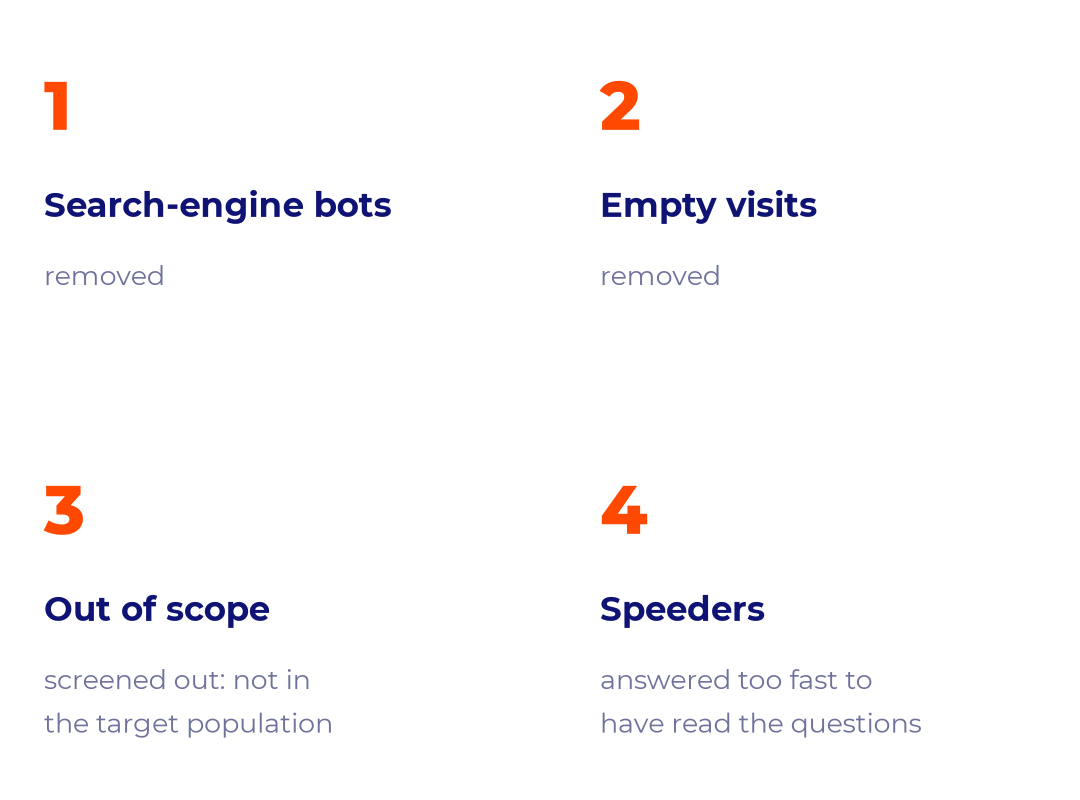
Data: the four checks behind the 15,665 verified employers
| Check | Treatment |
|---|---|
| Search-engine bots | Removed |
| Empty visits | Removed |
| Out of scope | Screened out: not in the target population |
| Speeders | Answered too fast to have read the questions |
GEURS 2027 employer survey, fielded 17 Aug – 7 Sep 2026, 40 countries.
Who answered
They are a serious group. Nearly two thirds have more than ten years of experience. Seven in ten have personally worked with at least ten graduates in the past two years. On average, respondents rate their influence over hiring criteria at 6.8 out of 10.
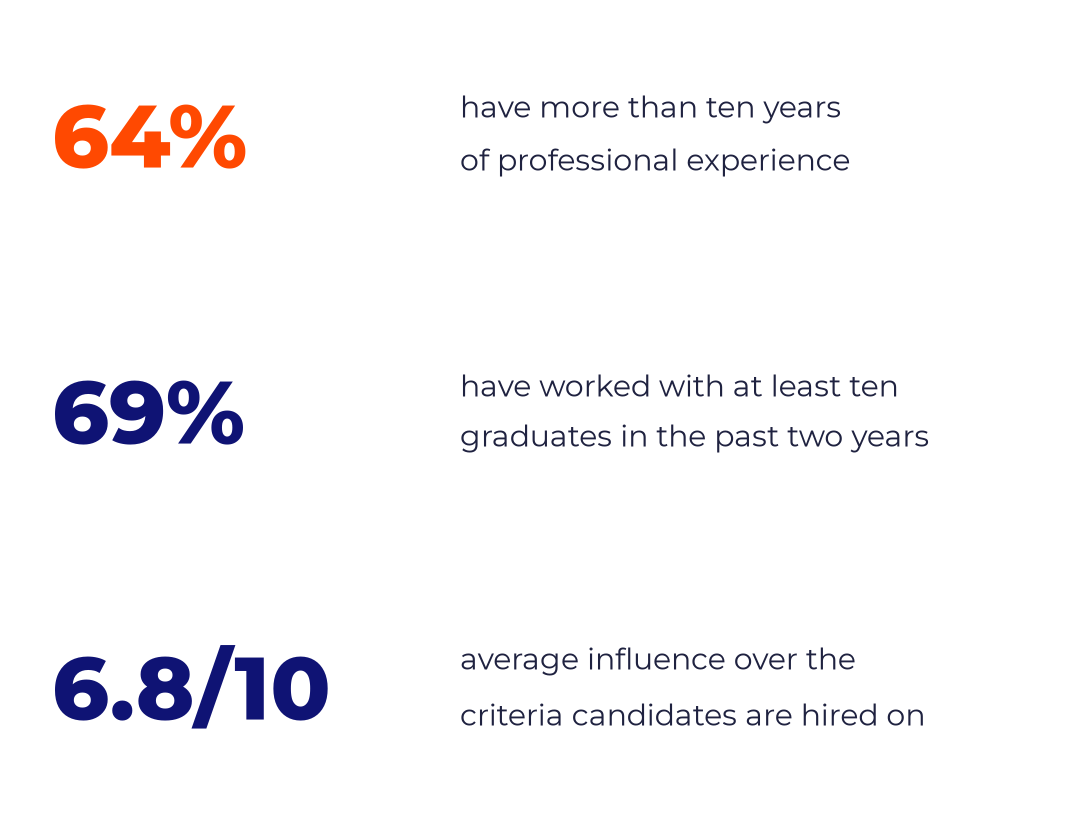
Data: profile of the respondents
| Indicator | Value |
|---|---|
| More than ten years of professional experience | 64% |
| Worked with at least ten graduates in the past two years | 69% |
| Average influence over the criteria candidates are hired on | 6.8/10 |
2
What they want: a strong common core
We went in expecting a map of differences. A German manufacturer and a Brazilian retailer, a bank in Seoul and a logistics firm in Lima, surely they want different things from a graduate. On the essentials, they share more than we expected: a strong common core, with each country and sector adding its own nuances.
The common core
Take one question as an example: which practical skills matter most when you hire a graduate? Across eight world regions, the general tendency is clear. Technical ability comes first overall, digital fluency second, and cross-border, cross-cultural experience last, a last place it holds in every region.
This common core shows up across the survey. We looked at every question by country, industry, company size, department and AI maturity. The general tendencies hold everywhere, and each segment adds its own emphasis: that is where the detailed results by country and sector come in.
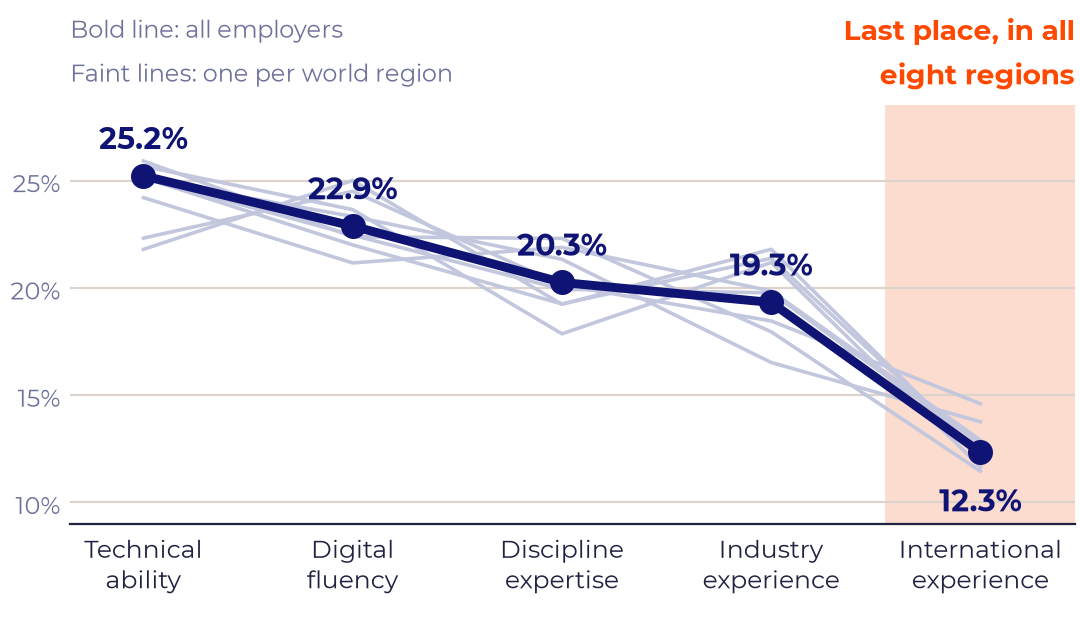
Data: practical skills that matter most when hiring a graduate, all regions (share of selections)
| Skill | Share of selections |
|---|---|
| Technical ability | 25.2% |
| Digital fluency | 22.9% |
| Discipline expertise | 20.3% |
| Industry experience | 19.3% |
| International experience | 12.3% (last in all eight regions) |
Share of selections, so groups that tick more boxes are not over-counted.
What employers actually want
Here are the tendencies worth knowing first. Start with AI. Ask around and you will hear that employers are desperate for prompt engineers and Python developers. Our data points to a different order of priorities. Asked which AI skills are in highest demand in their organisation, employers named implementation and integration first (30.7%), then strategy and use cases (28.8%), then training their own people (28.6%).
Prompt engineering came sixteenth of seventeen. Python for AI came last.
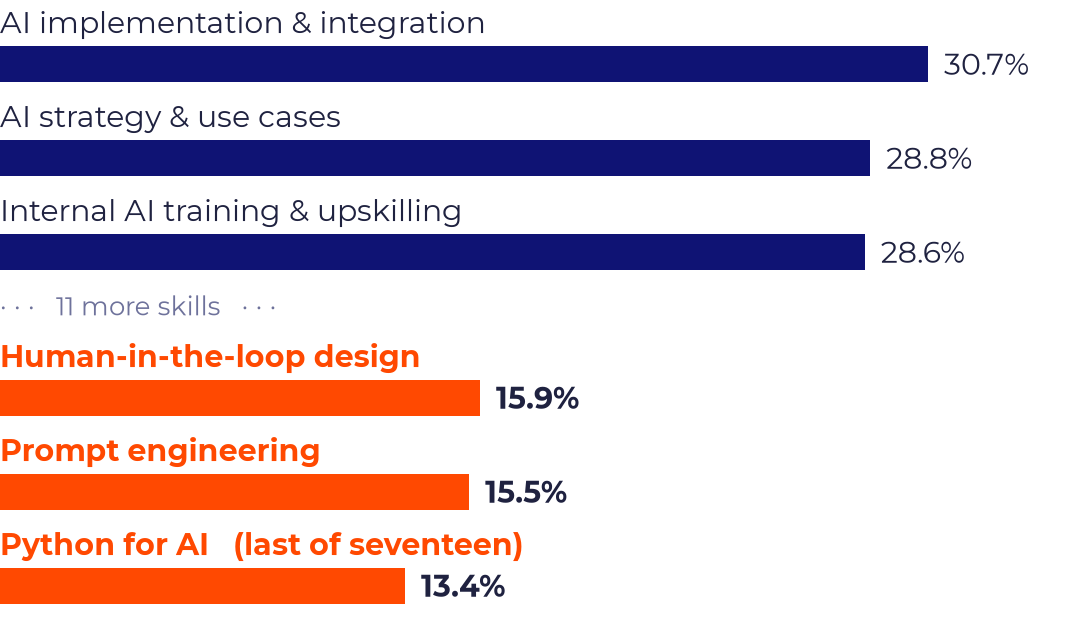
Data: AI skills in highest demand, three most and three least cited of seventeen
| AI skill | Rank | Employers |
|---|---|---|
| AI implementation & integration | 1st | 30.7% |
| AI strategy & use cases | 2nd | 28.8% |
| Internal AI training & upskilling | 3rd | 28.6% |
| Human-in-the-loop design | 15th | 15.9% |
| Prompt engineering | 16th | 15.5% |
| Python for AI | 17th | 13.4% |
Employers could pick as many as applied.
What holds AI back
Read the top of that list again and a pattern emerges: every one of those skills is organisational. Their leading priorities concern putting AI to work across the organisation. They are short of people who can get a model into a business that was not built for it, and keep it compliant once it is there. Their stated barriers say the same thing. Cyber security (32.3%) and worries about reliability and hallucinations (28.5%) rank far above budget (20.2%).
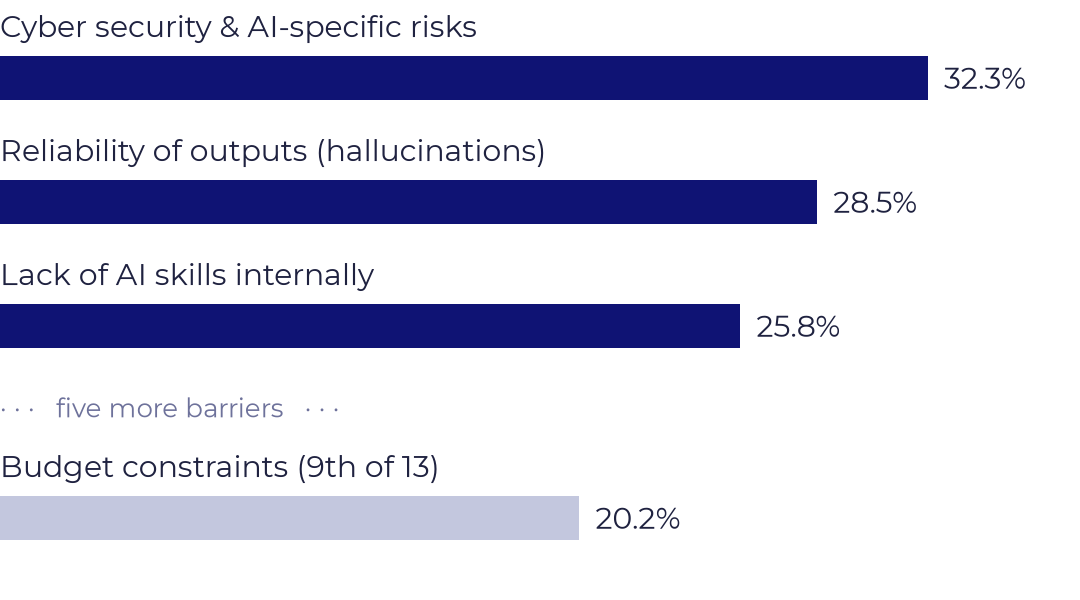
Data: barriers to AI in the organisation
| Barrier | Rank | Employers |
|---|---|---|
| Cyber security & AI-specific risks | 1st | 32.3% |
| Reliability of outputs (hallucinations) | 2nd | 28.5% |
| Lack of AI skills internally | 3rd | 25.8% |
| Budget constraints | 9th of 13 | 20.2% |
Employers could pick several barriers.
The contradiction
Then there is the contradiction at the heart of graduate hiring. We asked employers to rank four things by how decisive they are. Formal qualifications came last: 34.9% put credentials at the bottom. Then, a few questions later, we asked which signals actually matter when they look at a candidate. Internships and work exposure came first, at 65%. Degrees and certifications came second, at 59.5%.
Both answers are true, and together they describe how hiring really works. Qualifications remain an important signal. Practical experience helps candidates stand out. The internship decides what happens next. A qualification is necessary and almost never sufficient, which is exactly why employers rank it as the least decisive thing they look at while still requiring it.
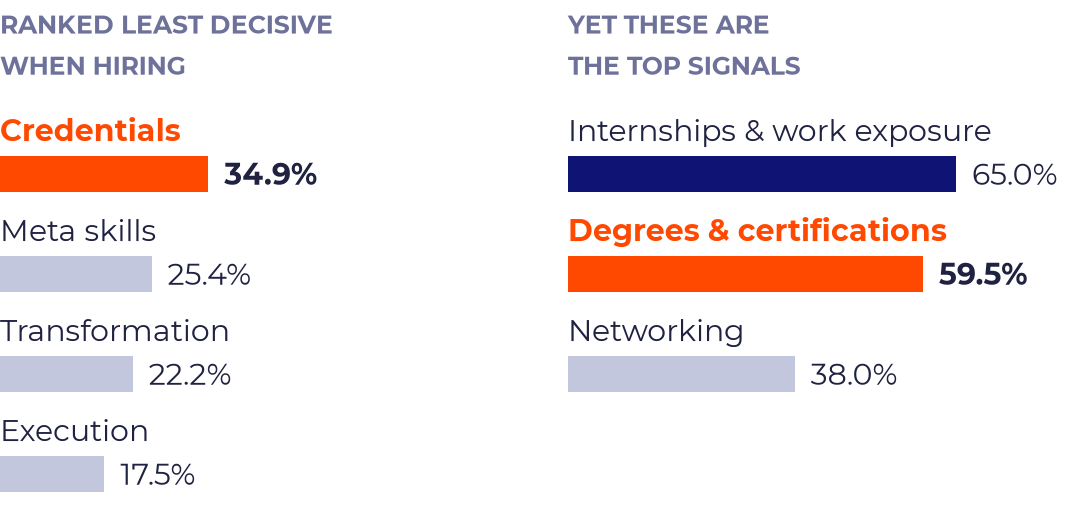
Data: ranked least decisive when hiring, and the signals that matter most
| Answer | Question | Employers |
|---|---|---|
| Credentials | Ranked least decisive | 34.9% |
| Meta skills | Ranked least decisive | 25.4% |
| Transformation | Ranked least decisive | 22.2% |
| Execution | Ranked least decisive | 17.5% |
| Internships & work exposure | Top signal | 65.0% |
| Degrees & certifications | Top signal | 59.5% |
| Networking | Top signal | 38.0% |
3
How they work with universities
This is where practices vary the most.
The starting point
Nine in ten employers told us they have some kind of relationship with a university. Only 18.2% described it as deep and structured. Most of the rest is occasional: a guest lecture, a careers fair, an internship pipeline that nobody owns.
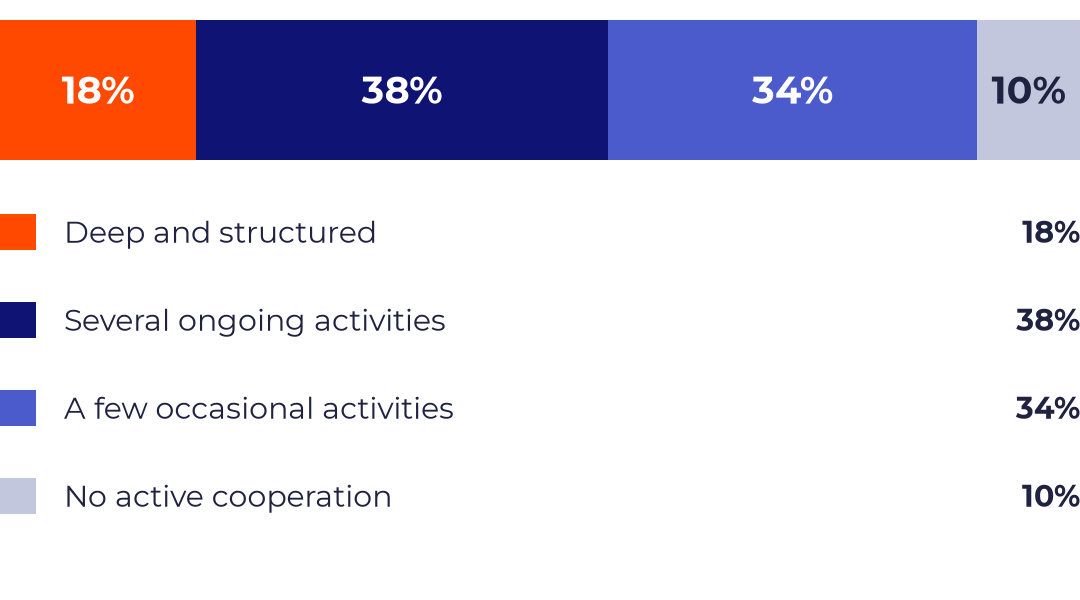
Data: how employers describe their engagement with universities
| Engagement | Employers |
|---|---|
| Deep and structured | 18% |
| Several ongoing activities | 38% |
| A few occasional activities | 34% |
| No active cooperation | 10% |
AI and cooperation
And one of the clearest dividing lines between deep and occasional partnerships is AI.
Among employers who describe themselves as AI-native, 45.5% have deep, structured cooperation with universities. Among employers not using AI at all, it is 6%. Seven and a half times the rate.
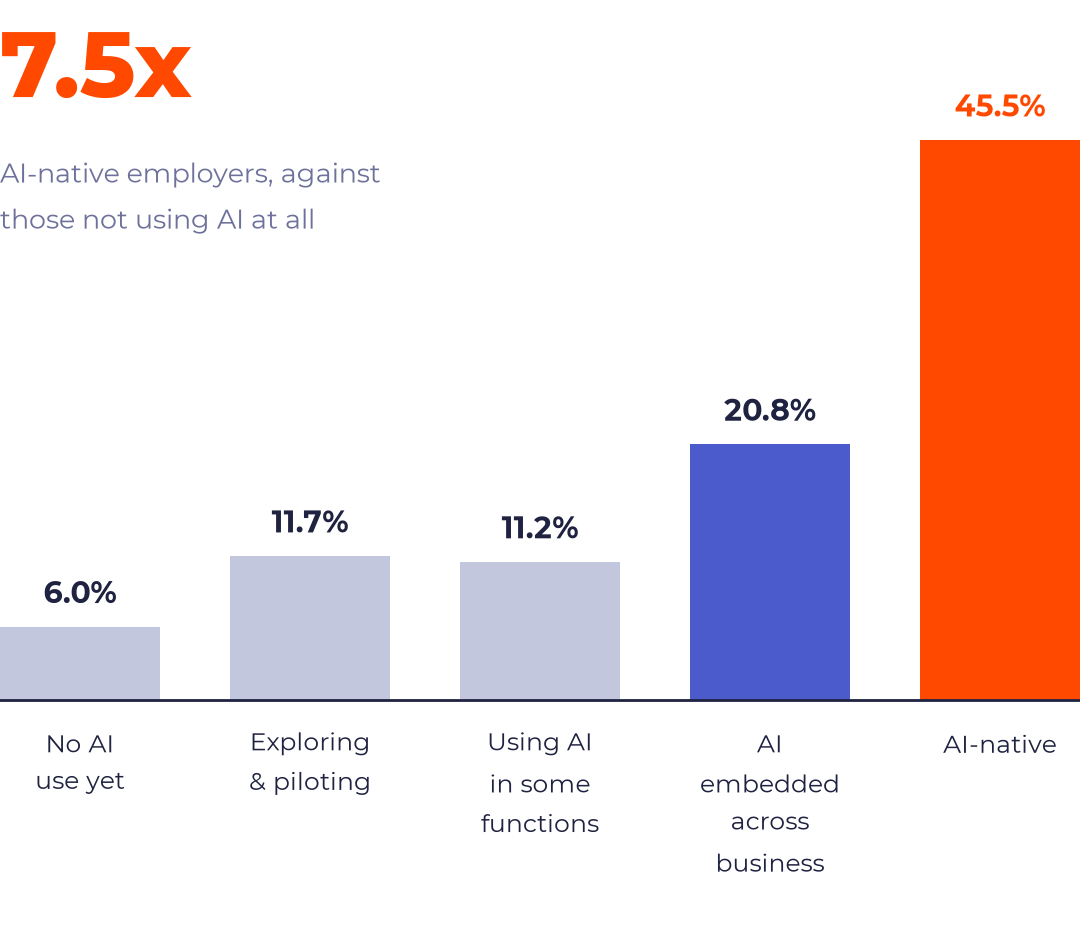
Data: deep, structured cooperation with universities, by AI maturity
| AI maturity | Employers |
|---|---|
| No AI use yet | 6.0% |
| Exploring & piloting | 11.7% |
| Using AI in some functions | 11.2% |
| AI embedded across business | 20.8% |
| AI-native | 45.5% |
The AI partner
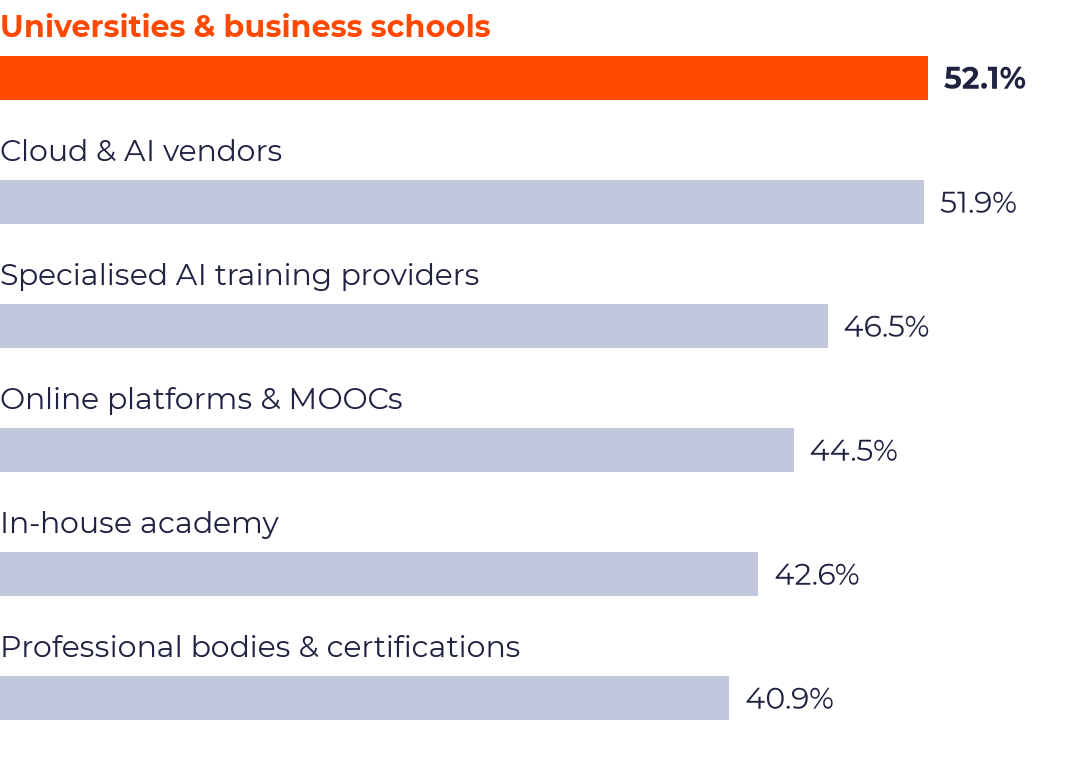
It is one of the strongest relationships in the survey, and it runs in a direction universities should find encouraging: when employers decide to build AI capability seriously, universities are the partner they name first: 52.1% say they are well prepared to build AI skills with a university, narrowly ahead of cloud and AI vendors at 51.9%.
Data: well prepared to build AI skills with each type of partner
| Partner | Employers |
|---|---|
| Universities & business schools | 52.1% |
| Cloud & AI vendors | 51.9% |
| Specialised AI training providers | 46.5% |
| Online platforms & MOOCs | 44.5% |
| In-house academy | 42.6% |
| Professional bodies & certifications | 40.9% |
Beyond borders
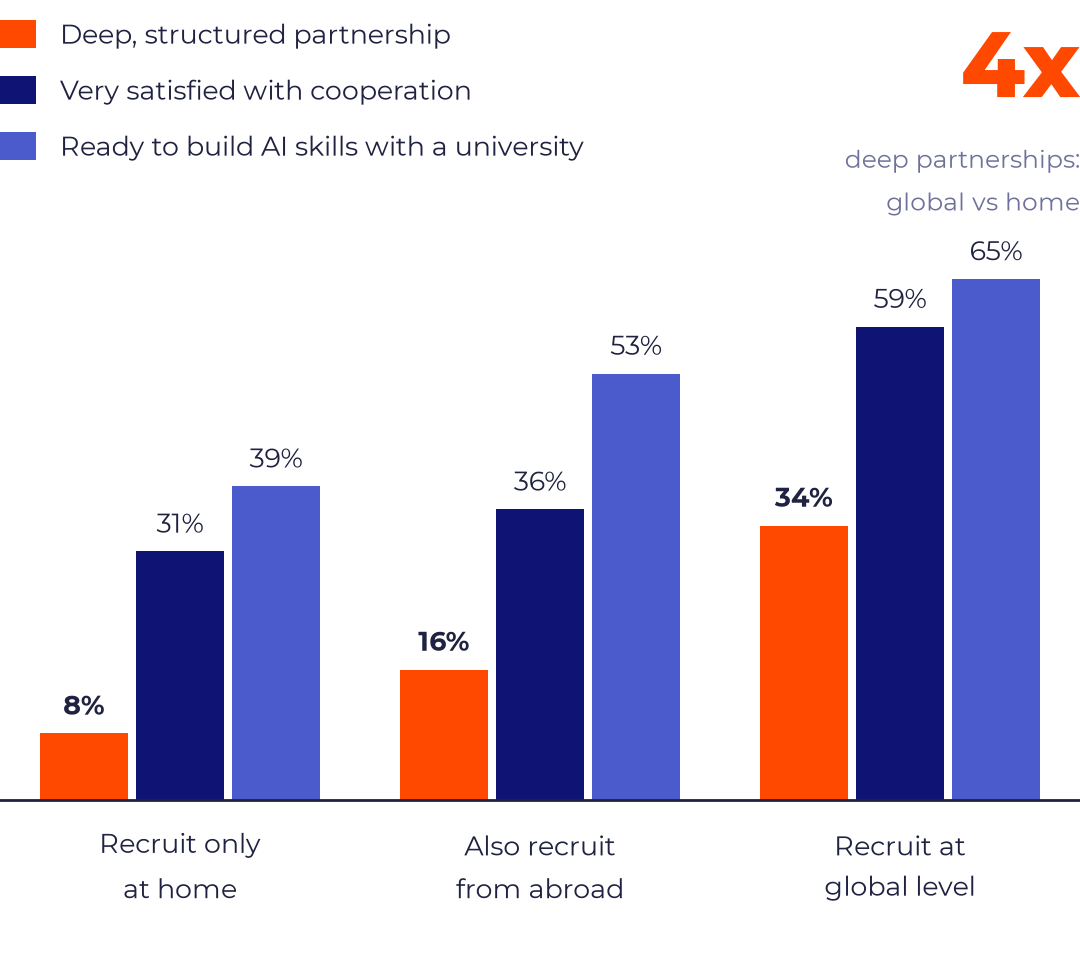
AI is not the only dividing line. Employers who recruit at global level are four times as likely as those who recruit only at home to have a deep, structured partnership with a university (34.3% against 8.3%), and almost none of them work without universities at all (3%, against 22%). The gap holds for companies of the same size and across levels of AI maturity.
These employers are also the most satisfied with their cooperation (59% very satisfied, against 31%) and the most ready to build AI skills with a university (65%, against 39%). The more widely an employer recruits, the more it invests in universities.
Data: by how far employers recruit graduates
| Recruitment reach | Deep, structured partnership | Very satisfied with cooperation | Ready to build AI skills with a university |
|---|---|---|---|
| Recruit only at home | 8% | 31% | 39% |
| Also recruit from abroad | 16% | 36% | 53% |
| Recruit at global level | 34% | 59% | 65% |
What gets in the way
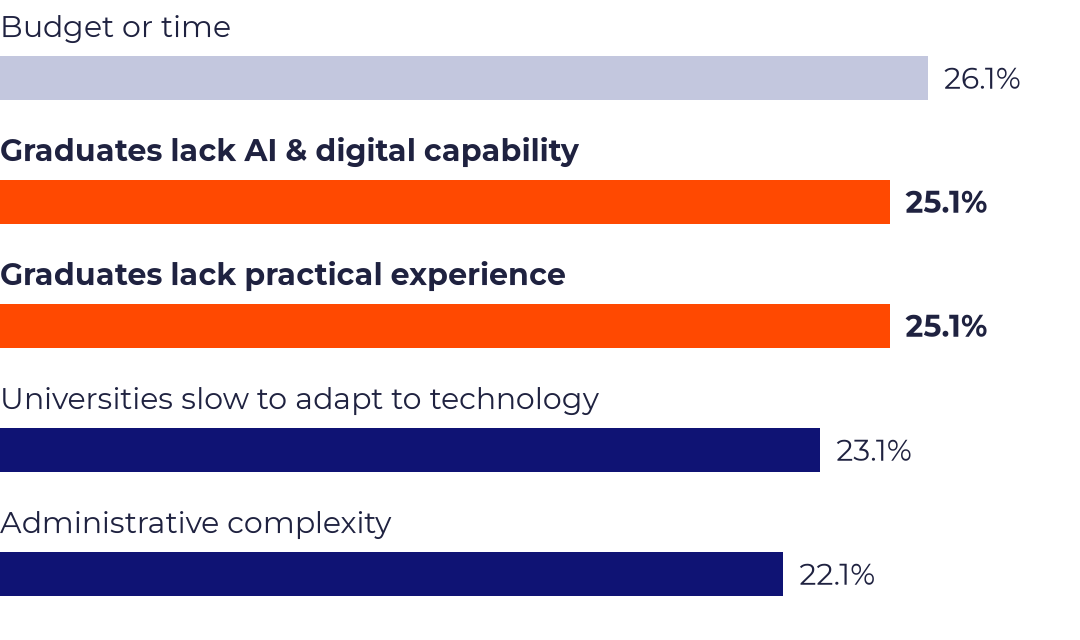
But the same employers are clear about what gets in the way. Budget and time come first (26.1%), followed closely by two gaps on the graduate side: a lack of practical experience and a lack of AI and digital capability (25.1% each), ahead of administrative complexity (22.1%).
Data: what limits the quality of cooperation with universities, five most cited factors
| Factor | Employers |
|---|---|
| Budget or time | 26.1% |
| Graduates lack AI & digital capability | 25.1% |
| Graduates lack practical experience | 25.1% |
| Universities slow to adapt to technology | 23.1% |
| Administrative complexity | 22.1% |
Employers could pick several factors.
The money question
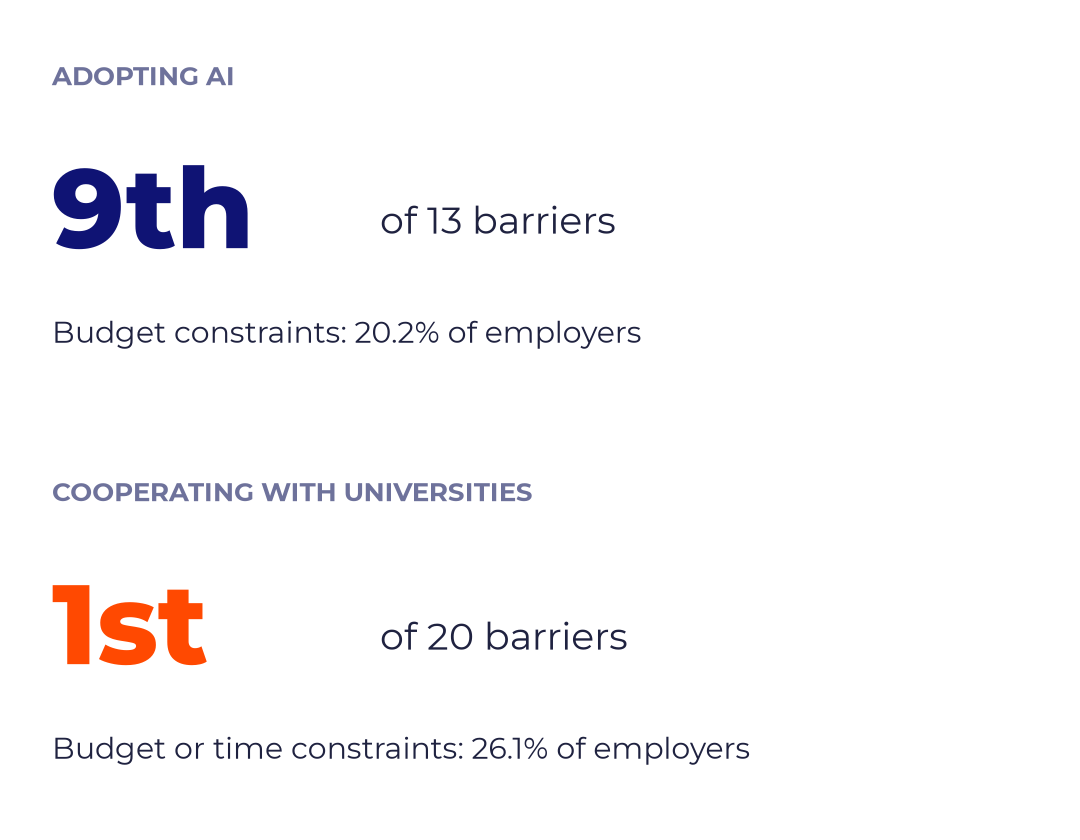
Notice the contrast with AI. When employers talk about adopting AI, money is a secondary concern: budget ranks only ninth of thirteen barriers. When they talk about working with universities, budget and time come first. For AI, the hurdles are trust and skills; for partnerships, they are budget and time. That is an opening for universities that make cooperation simpler and quicker to set up.
Data: where budget ranks among the barriers
| Context | Rank of budget | Employers |
|---|---|---|
| Adopting AI | 9th of 13 barriers | 20.2% |
| Cooperating with universities | 1st of 20 barriers | 26.1% |
Two separate questions; employers could pick several barriers in each.
What we haven't told you yet
These first findings open a much wider investigation into graduate employability. More than forty survey questions explore how AI is changing skill expectations, how employers assess candidates, what builds university recognition, and what makes cooperation work.
The next articles will examine these themes in greater depth: where AI capability is advancing and where it stalls; how partnerships move from occasional contact to structured cooperation; and which graduate outcomes matter most to employers.
The complete dataset allows us to explore these questions by country, sector, company size, department, seniority and AI maturity. Sixteen editions of GEURS add a longer perspective on how employer priorities have evolved.
This employer intelligence also connects with Emerging’s wider evidence: graduate career trajectories through Digital Leaders, alongside policy and labour-market data. Together, these sources help institutions understand their position, identify opportunities and anticipate shifts in talent pipelines.
The Global Employability University Ranking 2027 is published on 28 October 2026.
Driving employability · GEURS 2027
The authors of the study

Table of contents