
The GEURS 2027 ranks 300 institutions in 46 countries and territories through the eyes of employers. Each of them is recognised by employers for the employability of its graduates, and the employer survey sheds light on what that recognition rests on.

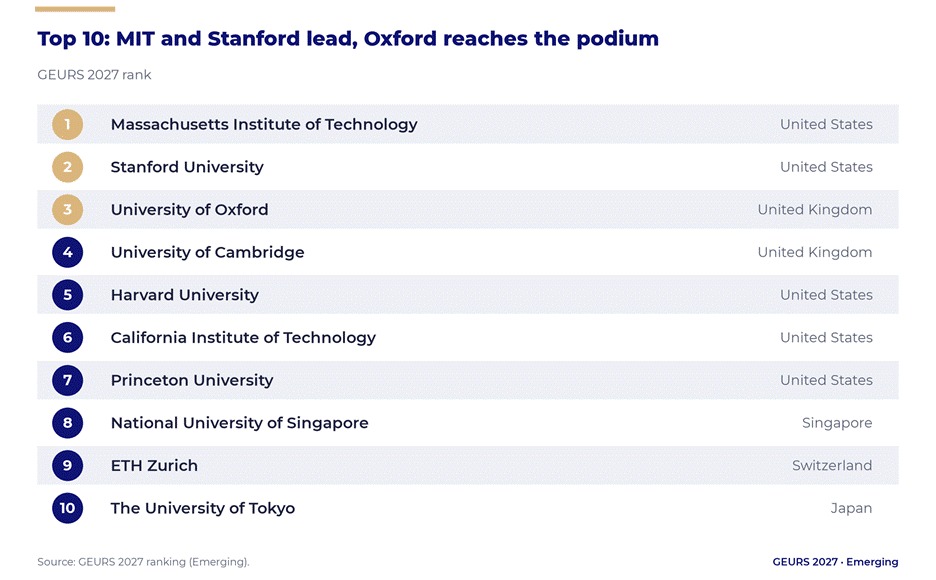
MIT keeps 1st place, Stanford University 2nd, and the University of Oxford reaches 3rd. The Top 10 remains largely stable, with eight of the 2026 institutions still present, while Princeton University (7th) and the University of Tokyo (10th) join it.
A wider ranking
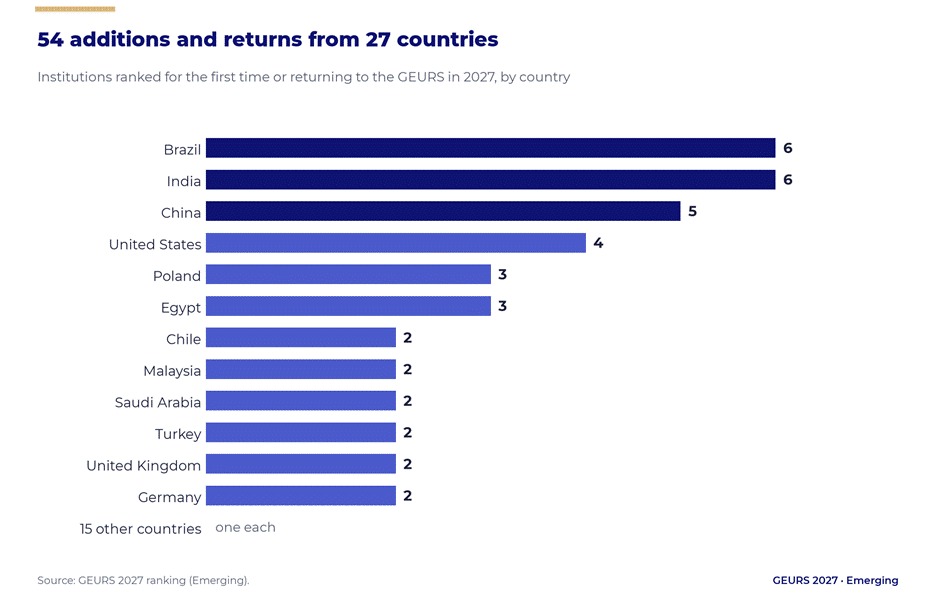
This year the GEURS grows from 250 to 300 institutions. The expansion brings 54 additions and returns: 32 institutions ranked for the first time and 22 that appeared in earlier editions, 13 of them within the Top 250.
These institutions come from 27 countries. Brazil and India contribute six each, China five and South Africa one: the ranking increasingly reflects the diversity of the higher education systems that employers turn to.
What employers recognise as employability
For each institution they select, employers indicate the main reason for their choice. Their answers spread across several attributes. Academic performance (19.3% of reasons), graduate skills (18.6%) and a focus on work expertise (17.2%) are cited most often, followed by impact and leadership (13.4%), specialisation (12.6%), internationality (10.0%) and reputation (8.9%).
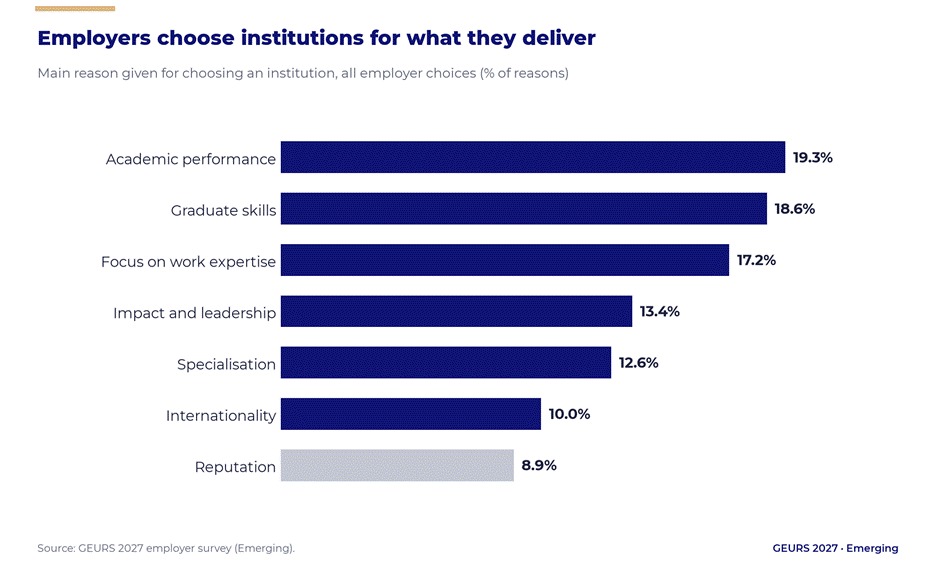
This balance is broadly similar across the ranking: graduate skills and academic performance each account for around a fifth of reasons in every part of the Top 300.
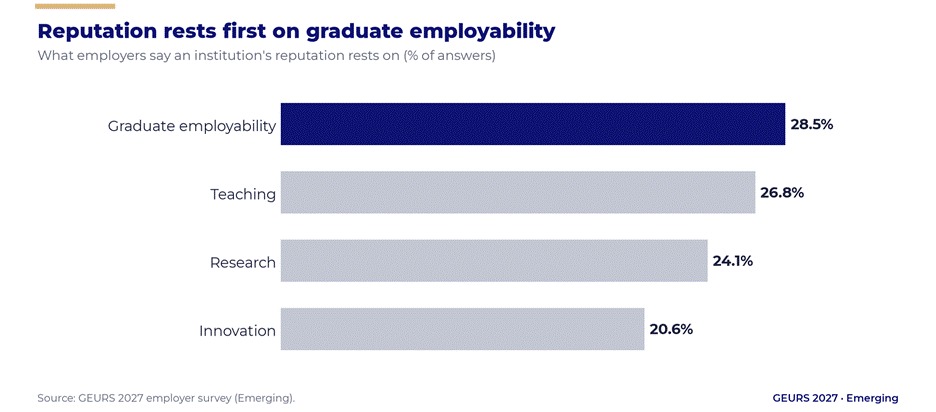
When reputation is cited, it is itself linked to tangible qualities. Asked what an institution’s reputation rests on, employers most often mention graduate employability (28.5% of answers), followed by teaching (26.8%), research (24.1%) and innovation (20.6%).
Different strengths
Employers’ reasons are not the same for every institution. Universities, engineering schools and business schools are each recognised for their own combination of strengths, and whatever the type of institution, reputation remains one reason among others.
Which attributes employers associate with which institutions, and how these profiles vary across countries and types of institution, will be explored in our forthcoming analyses of the GEURS 2027 employer survey. One thing is already clear: there is more than one route to employer recognition.
Around the world
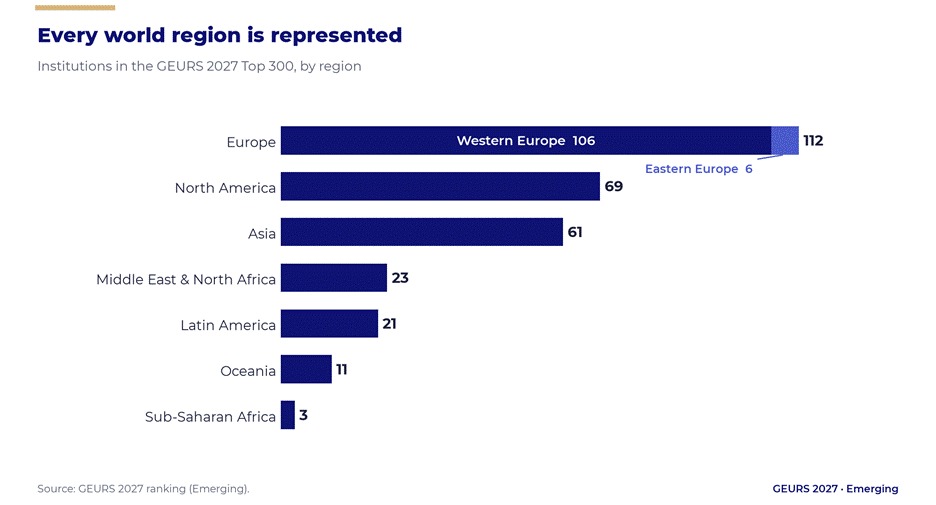
Behind the Top 10, every world region is represented in the GEURS 2027, and each tells its own story of progress. Rank movements refer to institutions ranked in both editions.
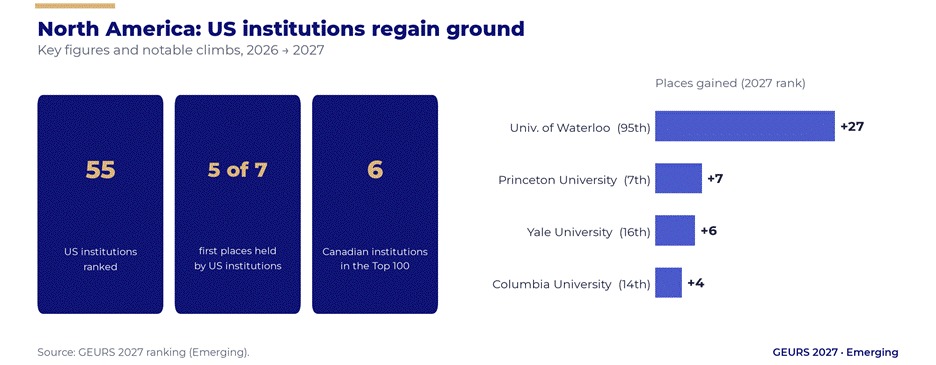
North America. The United States has 55 ranked institutions and five of the first seven places. Princeton climbs seven places to 7th, Columbia four to 14th and Yale six to 16th. Canada places six institutions in the Top 100, led by the University of Toronto (22nd), and the University of Waterloo climbs 27 places to 95th.
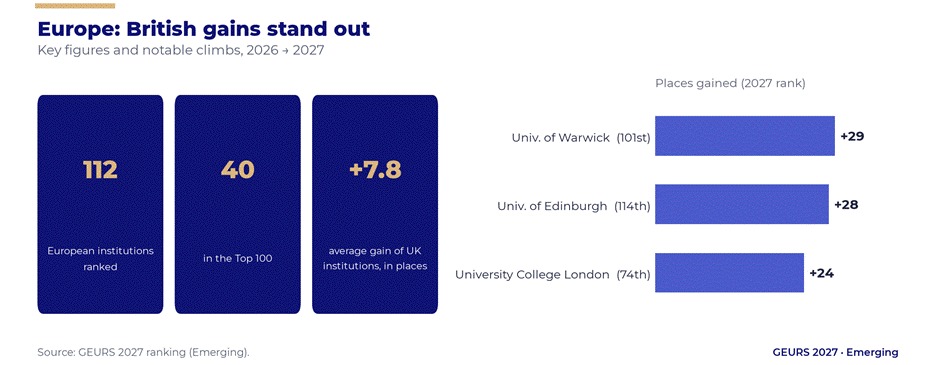
Europe. With 112 institutions and 40 of the Top 100, Europe is the largest regional contingent. The fifteen UK institutions ranked in both editions gain 7.8 places on average, with Warwick up 29 places to 101st, Edinburgh up 28 to 114th and University College London up 24 to 74th. Germany has the second-largest national contingent, with 21 institutions, and France places twelve in the Top 100, led by HEC Paris (27th) and École Polytechnique (28th).
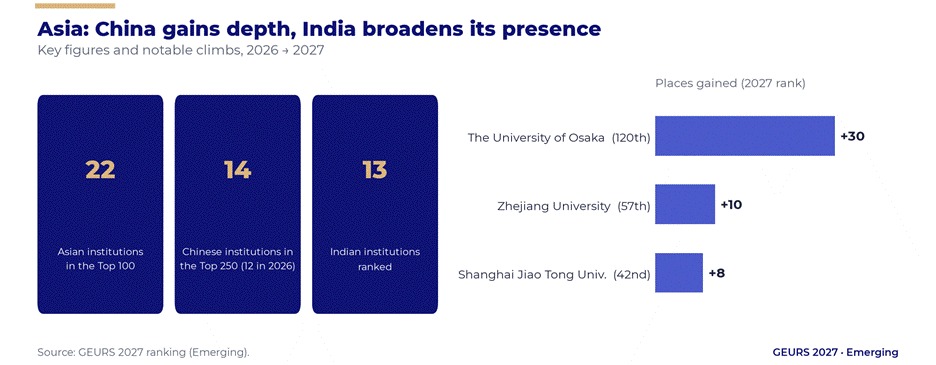
Asia. Asia places 22 institutions in the Top 100, led by the National University of Singapore (8th) and the University of Tokyo (10th). China has seventeen ranked institutions, fourteen of them in the Top 250 compared with twelve in 2026; Shanghai Jiao Tong gains eight places to 42nd and Zhejiang ten to 57th. The University of Osaka records the largest climb in the ranking, up 30 places to 120th. India reaches thirteen institutions in the expanded table, led by IIT Delhi (36th).
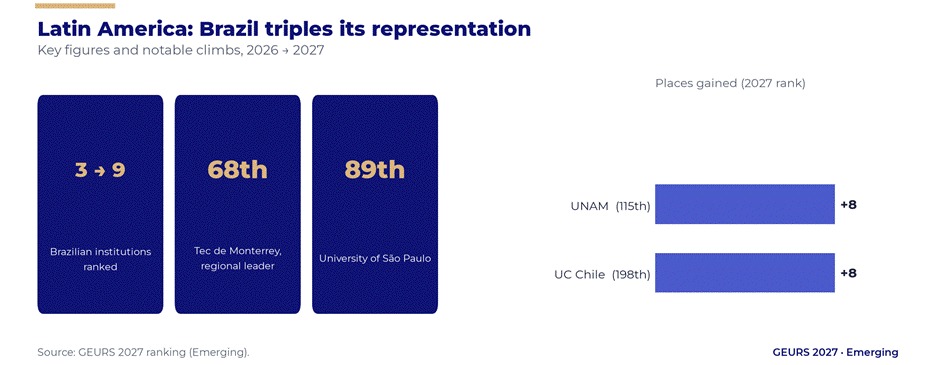
Latin America. Brazil triples its presence, from three to nine institutions, and becomes the region’s largest national contingent; São Paulo State University enters at 245th. Tec de Monterrey leads the region (68th), ahead of the University of São Paulo (89th). UNAM gains eight places to 115th, as does the Pontificia Universidad Católica de Chile, which enters the Top 200 at 198th.
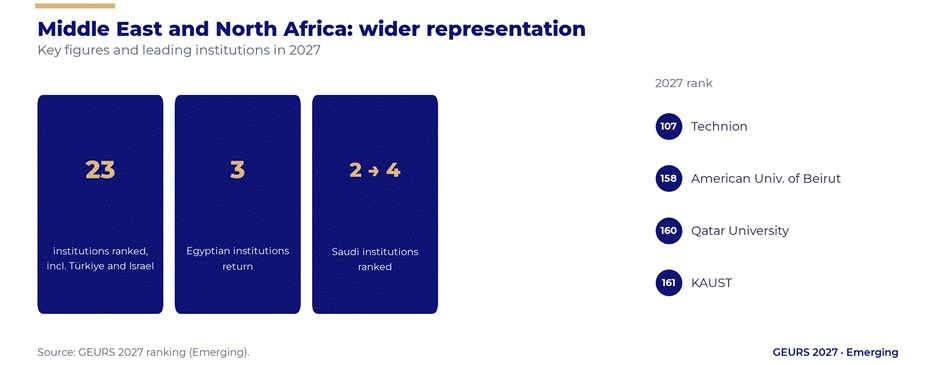
Middle East and North Africa. Across the region, including Türkiye and Israel, 23 institutions are ranked. Egypt returns with three institutions and Saudi Arabia doubles its representation to four, with King Fahd University of Petroleum and Minerals entering at 240th. The Technion leads the region (107th), followed by the American University of Beirut (158th), Qatar University (160th, up four places) and KAUST (161st).
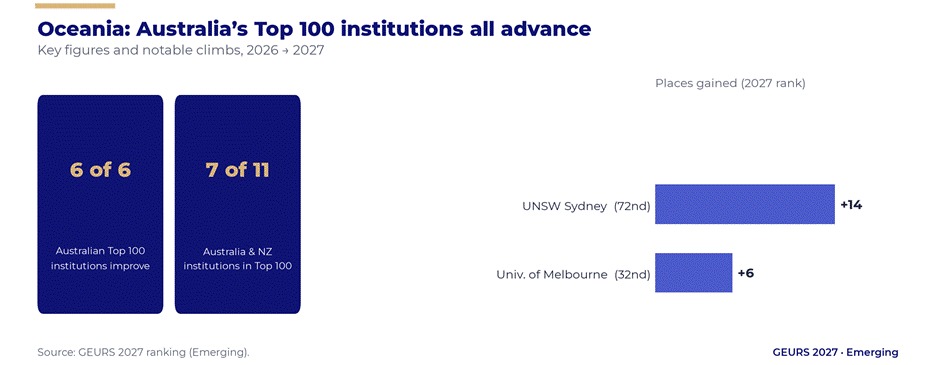
Oceania. All six Australian universities in the Top 100 improve their position: Melbourne gains six places to 32nd and UNSW Sydney fourteen to 72nd. With the University of Auckland (93rd), Australia and New Zealand place seven of their eleven ranked institutions in the Top 100.
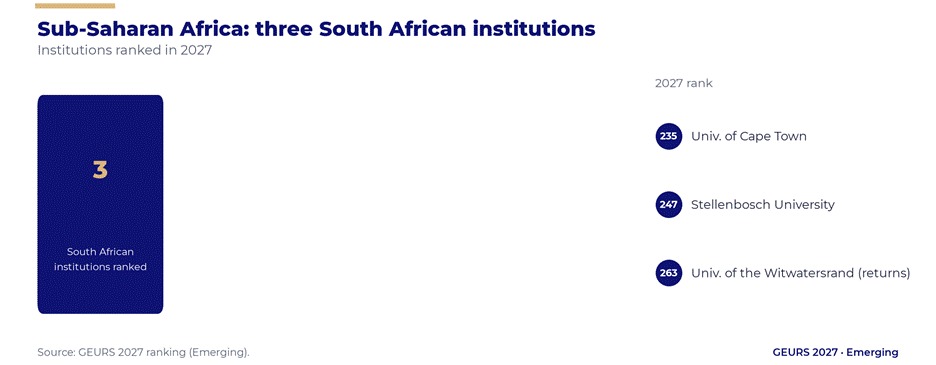
Sub-Saharan Africa. The region is represented by three South African institutions: the University of Cape Town (235th), Stellenbosch University (247th) and the University of the Witwatersrand, which returns at 263rd.
What it means for institutions
Every institution in the GEURS 2027 owes its place to employers’ recognition of its graduates. What differs is the combination of strengths behind that recognition.
For institutions, understanding which attributes employers associate with them, and which could be made more visible, is a useful starting point for building relationships with employers. This is what the GEURS employer survey helps to reveal, edition after edition.
Method and limits
The 2027 ranking covers 300 institutions in 46 countries and territories. The methodology is unchanged from the previous edition. Comparisons with 2026 are made on the Top 250, the scope of the previous edition. Survey data describe the choices of the recruiters surveyed, unweighted; they shed light on the ranking but are not its calculation.
Survey shares are shares of choices: for each institution selected, employers give one main reason. Results by type of institution group universities, engineering and science and technology schools, and business schools.
The authors of the study

Table of contents